%20(1).avif)
Execution is free.
So is everyone else's.
The cost of execution — defined here as the completion of discrete tasks: drafting a document, writing a script, delegating work, running an analysis, producing a design — across virtually every knowledge-work domain is collapsing toward zero. What once required specialist teams and weeks of effort can now be produced in hours by anyone with access to the same tools. And access to those tools is, by design, universal.
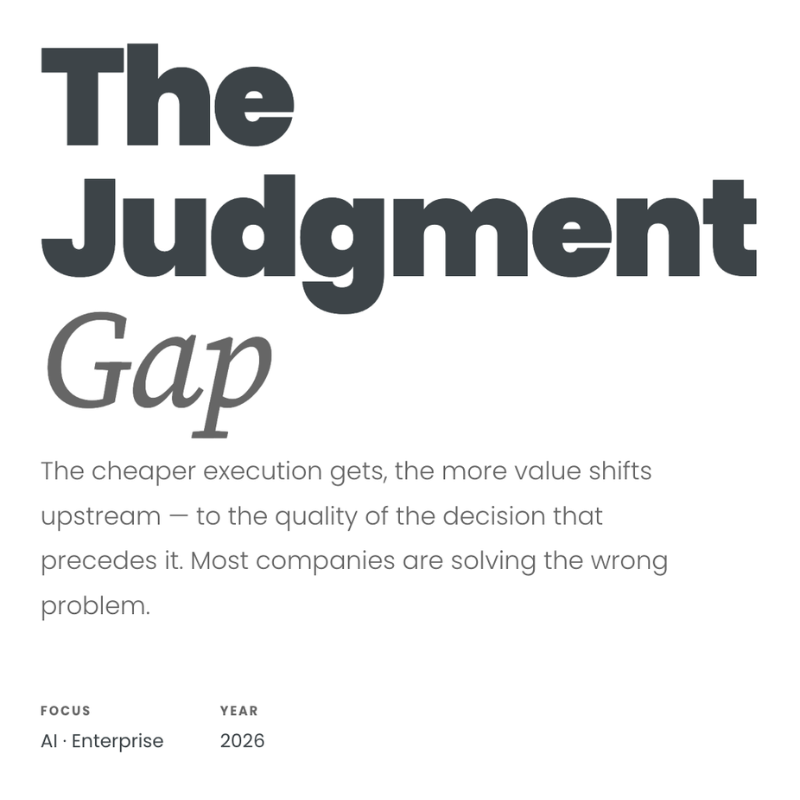
When everyone executes equally well, execution stops being a differentiator. The competitive advantage moves upstream — to judgment: the ability to decide what to do next. Which market to enter. What to build. Where to focus. Not gut feeling — but how accurate and current your picture of reality actually is. The better your judgment, the better every decision downstream of it.
You set direction.
The loop does the rest.
The companies that win won't be the ones with the sharpest instincts at launch. They'll be the ones who build a product that encodes judgment into a loop — and lets that loop compound over time.
Every customer interaction, every workflow completed, every decision made inside the product is a signal. The product learns what good looks like. Over time it knows things about the problem that no human team could know alone.
Humans don't disappear from this picture — they move up a level. They set direction rather than operate within it. The system handles the rest.
This is the opportunity available in almost every market. The question is not what insight you need to build the right product. That framing still puts judgment in the human.
The deeper question is whether the product itself becomes the thing that accumulates judgment over time — turning every interaction, every signal, every outcome into sharper decisions. And in most markets, nobody has built that product yet.
That loop, once closed, compounds. Not because it moves faster — but because it moves right, consistently, at scale.
Three stages of
competitive advantage
In most markets,
nobody has closed
this loop yet.
The window is open. The tools exist. The architecture is understood. What's missing is the decision to build for compounding judgment rather than faster execution.
Haven't the model providers already closed this loop? In one sense, yes. At the level of generic capability, the loop is closed. A foundation model trained on the internet knows what the internet knows.
But the more consequential loop — the one that encodes what good looks like inside a specific industry, a specific workflow, a specific regulatory reality — remains wide open. And it is structurally difficult to close from the outside. Not because the technology is hard to replicate. It isn't. But because the signal it needs doesn't live in public data.
It lives in the tacit knowledge of auditors and engineers who have seen a thousand edge cases. In the patterns of customer behaviour that no survey has ever surfaced. The kind of deep market understanding that traditional research is too slow, too expensive, and too shallow to capture.
Scale closes the generic loop. It doesn't close yours.


.jpg)
.jpg)


.avif)

.avif)
.avif)

.avif)
.avif)
.avif)
.avif)


.avif)


.avif)














.avif)